This website is an independent guide to home services.

Compare · Springs

Torsion vs Extension Springs

Published

Every sectional garage door is heavy enough that the opener could not lift it alone for long, so a spring system does nearly all the lifting.

Stop: this part is under high tension
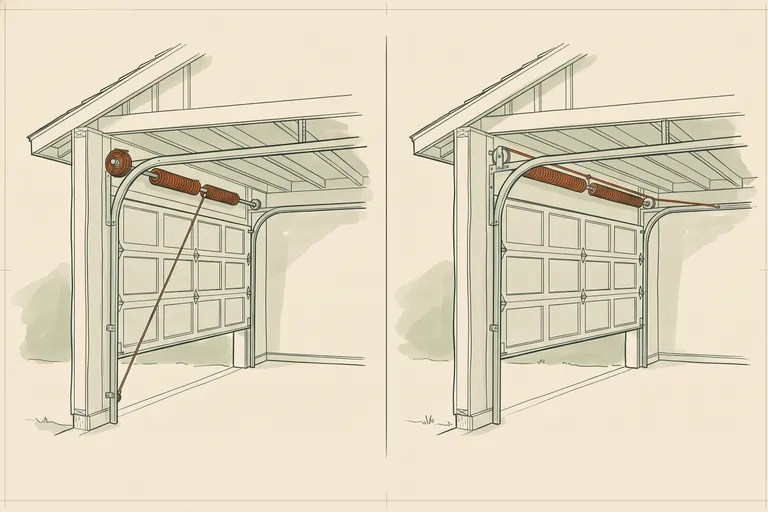
Two garage doors in elevation: one with a torsion spring above the door, one with extension springs at the sides
Fig. 1Torsion and extension springs in elevation, drawn to explain and not to scale. This is a drawing. Do not lift the door.

Short answer

What is the difference between torsion and extension springs?

A torsion spring is a coil above the door. Extension springs run along the sides of the door. Both carry the door’s weight under high tension. You can tell which type you have by looking from the floor. Call a trained garage door technician to inspect either one.

Spring systems come in two designs, torsion and extension, and they differ in where they sit, how they store energy, how they wear and what happens when they fail.

Both designs are drawn below, one after the other and then side by side, for comparison with the springs visible from the floor.

Watch them work

Watch each spring as the drawing moves

Both drawings move together when you use the controls.

Torsion

On a torsion setup, the spring winds tighter as the door comes down and releases that energy as the door rises. Drums sit at the ends of the shaft, and the lift cables wrap around them.

If one breaks: it usually stays on its shaft, but the sudden loss of lift can still bring the door down hard or leave it stuck.

Extension

Extension springs reach the same result another way, stretching as the door lowers and drawing back as it climbs.

If one breaks, read the spring and cable safety notice and keep clear.

Fig. 2 · Move the drawing with the slider or the button. It is only a drawing: do not lift or push your own door, or any real door. Drawn to explain, not to scale.

How they work

How each spring type carries the door

Same job, lifting the door’s weight, done in two different places.

Type A

Torsion spring

Drums sit at the ends of that shaft, and the lift cables wrap around them.

As the door goes up, the coil unwinds and hands that stored energy back as lift.

The result is a door that feels light in the hand and travels in a fairly even, controlled way.

Heavier doors often carry a pair of coils on the same shaft, sized to match the weight of the door.

A coil that is wrong for the door shows up as a door that drifts open on its own or drops shut too quickly.

Type B

Extension springs

They show up often on older or lighter doors, and the lift they give tends to be less smooth than a torsion setup provides.

A stretched extension spring that snaps can fly through the garage.

Stop: this part is under high tension.

A garage door spring stores a great deal of force, and it can let go without any warning. Stop here and call a trained technician.

Stop: the cables are under high tension.

Lift cables carry the weight of the whole door, and a loose end can whip or let it fall. Stop, stay clear, and call a trained technician.

At a glance

Side-by-side comparison

Four points that differ between the two designs, in the order homeowners tend to notice them.

Torsion springs and extension springs compared
PointTorsionExtension
Where it sitsOn a shaft above the openingAlong the horizontal tracks on both sides
Feel of the doorA balanced, even liftCan feel less even, especially as the springs age
Typical doorsHeavier or taller doorsOlder, lighter doors
If one breaksIt usually stays on its shaft, but the sudden loss of lift can still bring the door down hard or leave it stuck.A stretched spring that snaps can fly through the garage, which is why a cable through the middle of each spring matters.

Identify yours

How to tell which type your door has

Four things to look for, all from a safe distance and all by eye.

  1. 1

    Look above the door opening from a safe distance: a long metal shaft with a coil and drums at the ends points to torsion springs.

  2. 2

    Look beside the horizontal tracks near the ceiling: long coils stretched along each side point to extension springs.

  3. 3

    Check whether a thin cable runs through the middle of each extension spring; if it is missing, mention that to a technician.

  4. 4

    Look for pulleys at the upper track and cables at the lower corners, which both designs use in different arrangements.

Common questions

Questions people ask about springs

Why do garage door springs break?

Springs wear with every trip the door makes, and metal fatigue eventually shows up as a crack or a gap in the coil.

Rust, heavy use, a door that is out of balance and a spring that was never sized correctly for the door all hasten the end.

A loud bang from the garage followed by a door that will not lift is a common sign.

Should the springs be replaced together?

On a door with a pair of matched springs, a broken spring suggests its partner has seen the same wear and may be close behind.

Ask the technician whether both should be changed during the same visit, and what they see in the spring that is still intact.

Can you replace a torsion spring yourself?

No. A loaded torsion spring can let go of its energy without warning, and improvised tools make that far more dangerous.

The same applies to extension springs, cables and the brackets at the bottom of the door, which are under load even when the door is closed.

This work belongs to a trained garage door technician with the right equipment.

Thinking about switching types?

Moving from extension springs to a torsion setup involves different hardware on the door and the wall above it, so it is a conversation to have with a technician who can look at the door’s weight and condition.

A good answer explains what would change, what stays the same and why the recommendation fits your door rather than doors in general.

If a spring has broken

If a spring has broken, keep people and vehicles clear of the door. Do not run the opener. Do not push the door. A broken spring means the door is no longer held up.

The Garage Door Spring and Cable Safety: When to Call a Professional guide covers what failure looks like and what to do while you wait.

Before you call

What to note before you call a technician

  1. From a safe distance, note which spring design you see and whether any coil shows a visible gap.

  2. Write down any loud bang, and whether the door was opening or closing when it happened.

  3. Check for frayed or slack cables, and for a door that looks crooked or sagging on one side.

  4. Take a clear photograph of the shaft or the tracks without reaching into the door’s path.

  5. Ask the technician how they size springs to the weight of the door and whether safety cables will be added if they are missing.