Bottom seal
The doorThe bottom seal is the flexible strip along the lower edge of the door that closes the gap against the floor.
Once it turns brittle or tears, drafts, leaves and water find their way in.
Reference · Glossary
Published
Garage door talk comes with its own vocabulary, and a quote or a repair visit makes more sense once the words are familiar.
Entries run from A to Z, written as definitions and never as repair instructions. Each carries a small tag for the part of the door it belongs to.
For the safety side of the lifting parts, see Garage Door Spring and Cable Safety: When to Call a Professional.
The bottom seal is the flexible strip along the lower edge of the door that closes the gap against the floor.
Once it turns brittle or tears, drafts, leaves and water find their way in.
Children should learn that the door is not a toy, that nobody plays or stands beneath it, and that the wall button and remotes are for adults.
Keep remotes and keypad entry numbers out of small hands.
The counterbalance, made of springs, cables and drums, carries most of the door’s weight, which keeps the door light to move.
Energy goes into the springs while the door lowers and comes back out as it climbs, which is why an opener that strains or a crooked-rising door suggests a balance problem.
A drum is the grooved wheel at each end of the shaft that winds the cable as the door travels.
The bottom bracket is the fitting at each lower corner of the door that holds the end of the cable, and work on it is left to a trained garage door technician.
Extension springs run alongside the horizontal tracks on each side and stretch as the door closes.
A safety cable often runs through the middle of each coil to contain a broken spring, and any repair belongs to a trained garage door technician.
For a side-by-side look at the types, see Torsion vs Extension Springs: What Differs.
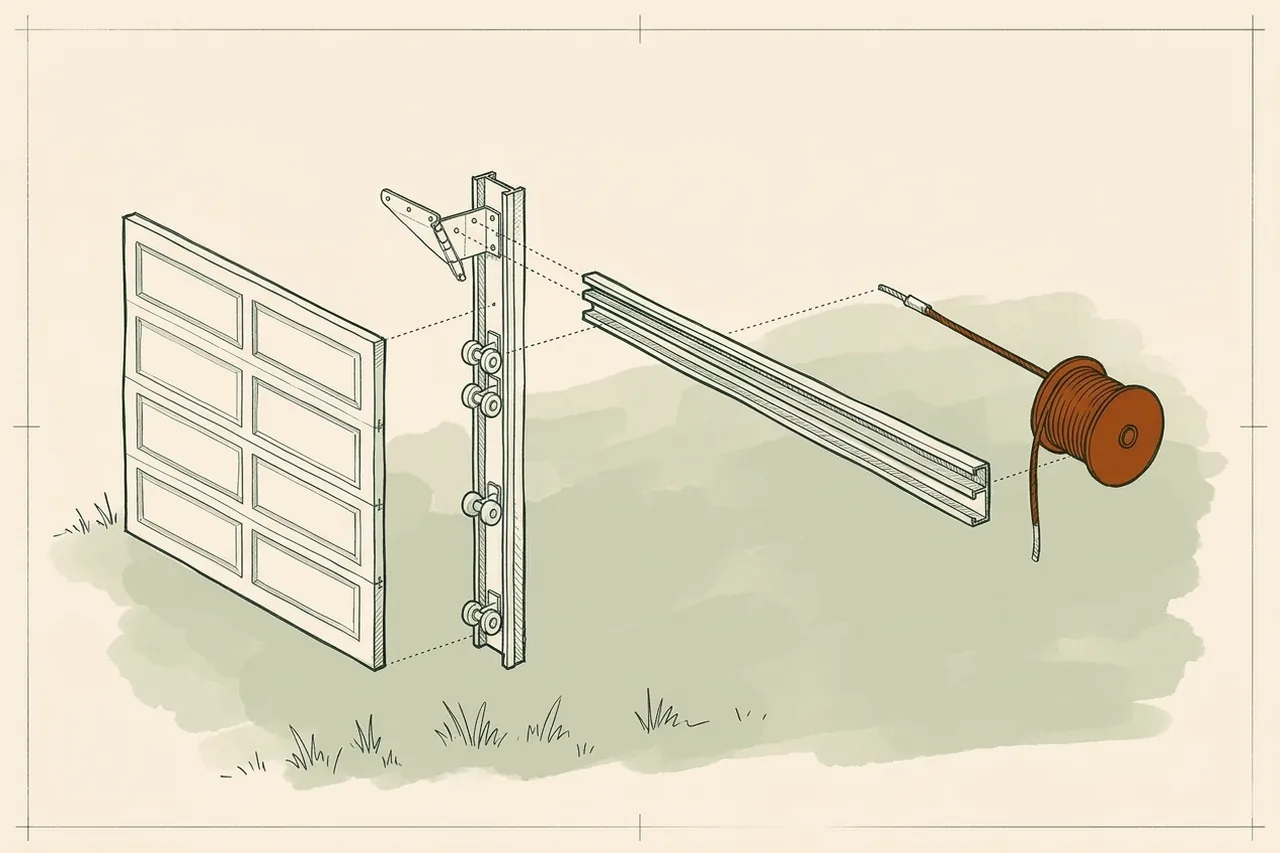
Hinges join neighboring panels and let the door flex exactly where it has to bend.
They also hold the stems of the rollers, so a cracked or loose hinge can make the door rattle or bind.
Lift cables run from the lower corners of the door up to the spring assembly and carry heavy load whenever the door moves.
A frayed strand or a slack cable is something to note from a distance and report, never to handle.
Stop: the cables are under high tension. Read why, on the safety page
The opener is the motor unit that guides the door up and down; it is built to steer a balanced door, not to lift its full weight.
When a spring has failed, the opener may strain or stall, and running it anyway can damage it.
A panel is a horizontal section of the door, the visible slab that carries the finish, any insulation and the mounting points for hardware.
The top and bottom panels hold special fittings, so they are not interchangeable with the middle sections.
The parts that move or flex on every trip, such as rollers, hinges, the bottom seal and the springs, tend to show age before panels and tracks do.
A well-kept old door can outlast a neglected newer one, so condition matters more than age.
For what to watch for, see Signs Your Garage Door Is in Trouble.
The red cord that hangs from the opener carriage is the release handle. Pulling it frees the door from the opener.
Adults in the household should know where it is. Do not pull it on a door that is raised, stuck or crooked, or after a bang. A released door can fall, and a door in any of those states can drop with its full weight. Call a trained garage door technician to inspect the door. The springs are left to a trained garage door technician.
Rollers are the small wheels at the hinges that ride inside the track, some made of nylon and some of steel with bearings.
Grinding or squeaking often starts here, since these wheels turn every time the door moves.
Safety sensors, often called photo eyes, are a pair of small units near the floor on either side of the door that send a beam across the opening.
When something breaks the beam, a closing door reverses, and a dirty or misaligned sensor is a frequent reason a door refuses to close.
Safe checks for that problem are in Garage Door Won’t Close? Safe Checks Before Calling Anyone.
A sectional door is built from a series of hinged panels that fold past each other as the door travels, so it rides up under the ceiling rather than swinging out.
Because the whole door tucks overhead, the driveway side stays clear.
Not while it is moving, and not while it is held open only by a worn or damaged part.
A trained technician checks the springs and cables. From the floor, note the symptom (a sound, a crooked door, a gap) and report it.
A torsion spring is a tightly wound coil on a shaft above the opening, and it twists to store energy as the door lowers.
It holds enough stored energy to injure, so you keep clear and leave all work on it to a trained garage door technician.
Stop: this part is under high tension. Read why, on the safety page
The track is the steel rail on each side of the opening that guides the rollers up the wall, through a curve and then level beneath the ceiling.
A dent or a gap in the rail can make the door jump or stick, and that is a reason to call a technician rather than to force the metal back into shape.
The trolley slides along the opener rail, and the arm links it to a bracket at the top of the door.
A bent arm or a loose bracket can make the door move unevenly.
Keep reading