Plan a project · Guide
Repair or Replace Your Garage Door
Published
Deciding between fixing a garage door and swapping it out comes down to what is actually failing, how the whole assembly looks, and whether the repair would only buy a short delay.
This guide covers how the door works, what common symptoms point to, which observations are safe from a distance, and how to weigh the choice.
Short answer
Should you repair or replace a garage door?
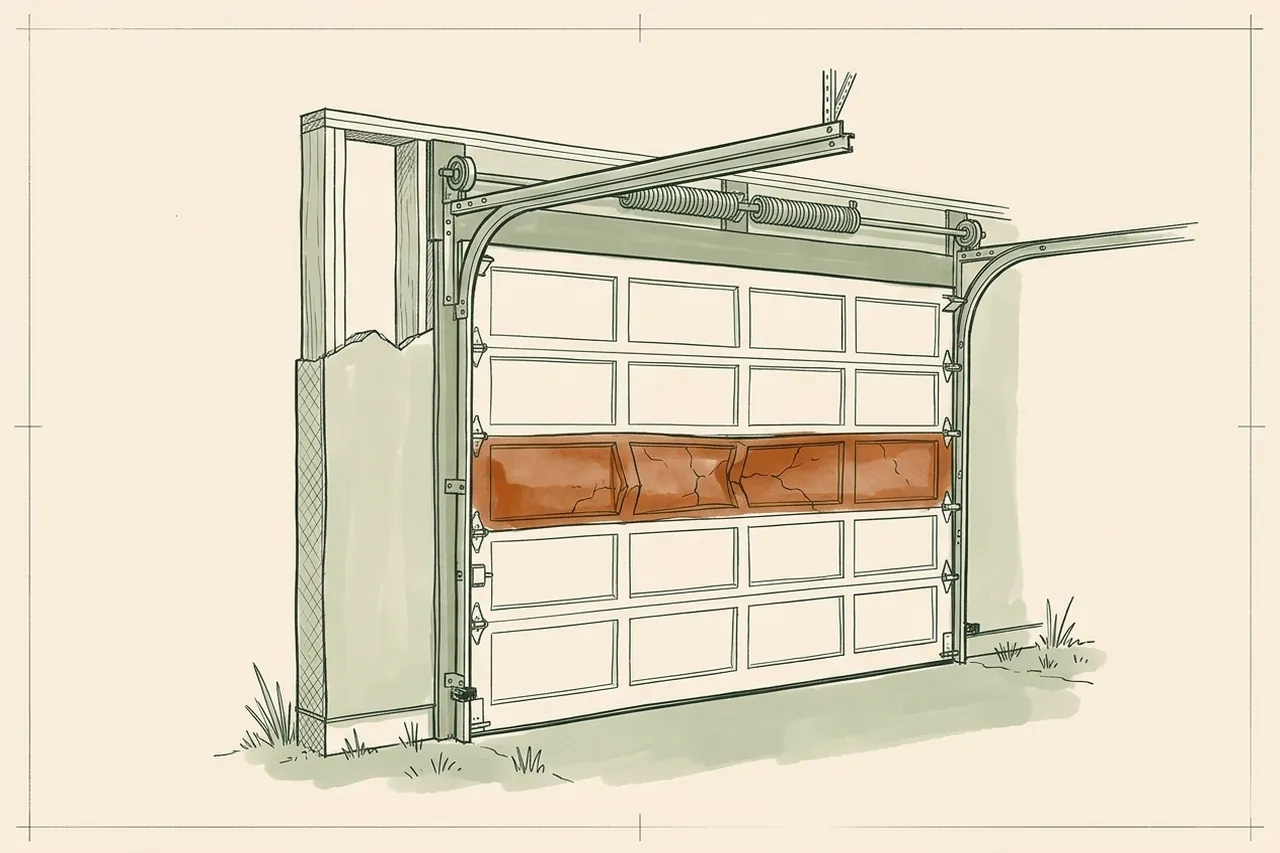
Repair suits a sound door with one worn part, such as a roller, a sensor or a weatherseal. Replacement makes more sense when several panels are damaged, the frame has rusted or rotted through, or unrelated failures keep returning. Look from a safe distance, note the history, and call a trained garage door technician to inspect the springs and cables.
The short version
Three things tip the decision
A worn roller or a misaligned sensor is a small job on a sound door, while crushed panels or a rusted-through frame are a different story.
Condition of the panels
Straight, intact panels point toward repair; widespread damage points toward replacement.
Repair history
A first problem points toward repair; a string of unrelated failures points toward replacement.
Energy and comfort
An uninsulated door under a living space may tip the decision toward a new, insulated model.
Reading the door
Which way does it lean?
Trouble usually shows up as a change in how the door sounds or moves. These are the signs that tend to point each way.
Repair
Signs that usually point toward repair
- A door that reverses for no clear reason often has a dirty or misaligned safety sensor, which is usually a quick job for a technician. Call a trained garage door technician to check the sensors.
- Squeaks that fade after hinges and rollers are cleaned and lubricated suggest simple wear.
- A cracked panel on an otherwise straight door can sometimes be addressed without touching the rest.
- A remote that works only up close points to the battery or the receiver rather than the door.
- A worn weatherseal along the bottom lets in drafts and leaves, yet leaves the door itself perfectly serviceable.
Replacement
Signs that usually point toward replacement
- Several panels that are dented, bowed or delaminating, especially along the hinge lines, keep pulling the door out of alignment.
- Rust that has eaten through the lower edge of steel panels, or rot in a wood door, tends to come back after a patch.
- Repeated visits for different parts suggest the whole assembly is tired, and the invoices add up while reliability does not improve.
- A door with no insulation in a garage that you heat or use as a workspace may be worth upgrading rather than patching.
- Hardware or panels that the manufacturer no longer supplies can make even a small repair a custom job.
How it works
What holds the door up
Knowing which part does what makes a technician’s explanation easier to judge.
How does a garage door stay up without the opener holding it?
A spring-based balance system does the lifting, not the motor, with steel cables at the bottom corners linking the door to it. How it works, in full.
When that balance is right, the door feels light and moves evenly along its tracks. A door that strains the opener, slams down or rises crooked is out of balance, which points to the springs or cables and calls for a trained garage door technician, not a homeowner test.
What is the opener really doing?
A failed spring so often looks like a failed opener: the motor strains, the door barely moves, or the unit hums and gives up.
Replacing an opener on a door that is still out of balance only moves the problem and wears the new motor quickly. The reverse also holds: a door that rises level and quietly but behaves oddly under power often points to sensors, opener settings or the opener itself, which a technician can tell apart.
Stop: this part is under high tension.
A garage door spring stores a great deal of force, and it can let go without any warning. Stop here and call a trained technician.
Stop: the cables are under high tension.
Lift cables carry the weight of the whole door, and a loose end can whip or let it fall. Stop, stay clear, and call a trained technician.
Sounds and symptoms
What to notice, and when to stop
Stop: this part is under high tension. Read why, on the safety page
From a safe distance you can observe a gap in a coil, a frayed cable, a door that rises crooked, or an opener that strains or slows. A door cannot be judged heavy from a distance, and its weight is not something to test. Do not lift the door.
Those parts, and the bottom brackets that hold the cables, are for a trained garage door technician.
Until then, leave the door alone and keep the area beneath it clear; Garage Door Spring and Cable Safety goes further.
Is a noisy garage door dangerous?
Squeaks and rattles are mostly a nuisance, but they can be an early warning that parts are wearing faster than they should.
A sudden sharp bang is different, because it is the typical sound of a spring or cable letting go. After a bang, stay clear of the door, do not run the opener, and keep people and vehicles out of its path until a trained garage door technician has looked at it.
Why is your garage door so loud?
A squeal often comes from dry hinges and rollers. If it seems to come from the spring or its end plates, stay clear and call a trained garage door technician to inspect it. A rattle often points to loose hinges, loose track brackets or a loose opener. Call a trained garage door technician to check it.
A grinding sound can come from tired rollers, a chain that has dried out, or tracks that have shifted out of line. If the noise stays after the hinges and rollers are cleaned, the likely cause is wear, and a trained garage door technician can inspect the parts.
What are the signs your garage door needs repair?
Trouble usually shows up as a change in how the door sounds or moves: a shake, a pop, a squeal, a slow or lopsided rise, or a door that suddenly makes the opener labor.
Jot down the moment it happens, whether on the way up, the way down or both, and what the opener does at that point. Those details let a technician narrow the cause on the phone and arrive with suitable parts.
What lubricant should you use on a garage door?
With the door fully closed and the opener unplugged or its power off at the breaker, the product the door maker recommends goes on as a thin film on the hinges and roller bearings that can be reached from the floor or a low step stool; anything higher goes to a trained garage door technician. Do not use a ladder for any garage door task. Any drips are wiped off. If the opener’s outlet is overhead, a trained garage door technician does the job.
Keep it off belts and plastic parts, and do not smear thick grease in the tracks, because it collects dust and grit. A technician can fit vibration isolators on the opener mount; this is overhead work, not a homeowner job.
Boise homes
How old your door and opener may be
About 57 in 100 Boise homes were built before 1990, ahead of the 1993 opener rule, so the age of the house is a first clue to the age of the hardware. A house can have a newer door than itself, so check the labels.
About 88 in 100 Boise homes were built in 2009 or earlier, and 57 in 100 before 1990
Share of housing units built in each period. Margins of error (90 percent) are in the table.
- Boise city
- Ada County
Show the numbers
| Built | Boise city | Ada County | ||||
|---|---|---|---|---|---|---|
| Homes | Margin (90%) | Share | Homes | Margin (90%) | Share | |
| 1939 or earlier | 6,561 | ±542 | 6.3% | 8,408 | ±767 | 4.1% |
| 1940 to 1949 | 3,833 | ±474 | 3.7% | 4,304 | ±501 | 2.1% |
| 1950 to 1959 | 7,529 | ±656 | 7.2% | 8,373 | ±731 | 4.1% |
| 1960 to 1969 | 8,158 | ±731 | 7.8% | 9,634 | ±812 | 4.7% |
| 1970 to 1979 | 18,618 | ±785 | 17.8% | 27,877 | ±1,046 | 13.6% |
| 1980 to 1989 | 15,053 | ±940 | 14.4% | 20,354 | ±1,129 | 9.9% |
| 1990 to 1999 | 20,541 | ±1,104 | 19.6% | 37,924 | ±1,505 | 18.5% |
| 2000 to 2009 | 11,900 | ±709 | 11.4% | 42,457 | ±1,632 | 20.7% |
| 2010 to 2019 | 11,312 | ±803 | 10.8% | 38,293 | ±1,407 | 18.7% |
| 2020 or later | 1,328 | ±279 | 1.3% | 7,444 | ±610 | 3.6% |
| All homes | 104,833 | ±1,060 | 100% | 205,068 | ±209 | 100% |
The counts cover all housing units, apartments and mobile homes included, not only homes with a garage door. The 1990 to 1999 group spans 1993.
Source U.S. Census Bureau, American Community Survey 2019-2023 5-year estimates, table B25034 (year structure built). Open the source (opens in a new tab). Checked .
Openers made on or after January 1, 1993 must meet the federal entrapment standard
Three dates from 16 CFR Part 1211. The years are not to scale.
Openers made from this date must carry the month or week and year they were made, and say they conform.
16 CFR 1211.19The entrapment protection standard applies to every residential opener made from this date.
16 CFR 1211.1An amendment was published. The eCFR lists it as pending, so check the current text before relying on this page.
91 FR 68459
You can read the date label on your opener from the floor. If there is no label, or it shows a date before 1993, ask a trained technician about the opener.
Show the numbers
| Date | What happens | Where |
|---|---|---|
| January 1, 1991 | Openers made from this date must carry the month or week and year they were made, and say they conform. | 1211.19 |
| January 1, 1993 | The entrapment protection standard applies to every residential opener made from this date. | 1211.1 |
| October 30, 2026 | An amendment was published. The eCFR lists it as pending, so check the current text before relying on this page. | 91 FR 68459 |
The eCFR lists a pending amendment (91 FR 68459, published October 30, 2026). The dates here are the rule as of November 1, 2026.
Source U.S. Consumer Product Safety Commission, 16 CFR Part 1211, through the Electronic Code of Federal Regulations (as of November 1, 2026). Open the source (opens in a new tab). Checked .
Boise averages about 108 freezing mornings a year, when springs and openers struggle
Average days each month with a low at or below 32 °F, with the average low as a line.
- Days with a low at or below 32 °F
- Average low (°F) (right axis)
Show the numbers
| Month | Days with a low at or below 32 °F | Average low (°F) |
|---|---|---|
| January | 25.5 | 25.5 |
| February | 20.1 | 29.0 |
| March | 11.2 | 34.9 |
| April | 5.2 | 39.6 |
| May | 0.8 | 47.5 |
| June | 0.0 | 54.1 |
| July | 0.0 | 61.9 |
| August | 0.0 | 60.8 |
| September | 0.2 | 52.6 |
| October | 3.7 | 41.5 |
| November | 16.3 | 31.7 |
| December | 25.2 | 25.4 |
| Year | 108.2 |
This is the airport station. Foothill and valley-edge homes can run colder. Normals are 1991-2020 averages, not a forecast.
Source NOAA National Centers for Environmental Information, U.S. Climate Normals 1991-2020, Boise Air Terminal (station USW00024131). Open the source (opens in a new tab). Checked .
Note when the trouble happens
Boise has about 108 freezing mornings a year, and cold is when a tired spring or opener tends to show it. If the door only struggles on cold mornings, tell the technician; it helps them find the cause.
Older garages can have narrow openings, odd headroom or a door that was cut to fit, which makes a stock replacement trickier and raises the value of a careful measurement.
If you rent, the decision usually belongs to the landlord, so a photo of the problem and a written report to the landlord come first, before anyone is hired.
Before you call
How to gather what you need before you call
Five notes on a phone or a sheet of paper make the call shorter and the answer clearer.
A good answer from a technician names the failed part, says what else is worn and explains what the repair will and will not fix.
Second opinion A vague push toward a full replacement with no description of the damage deserves a second opinion.
Notes for the call
When it happens
Write down when the problem happens and whether it began suddenly or crept in.
Photographs
Photograph the door from inside and outside, including any gap, dent, frayed strand or crooked rise, without standing under the door while it moves.
Opener make and size
Note the make and size if a label is visible, and whether the opener makes noise when the door will not move.
What the quote covers
Ask whether the quote separates parts, labor and any extras, and whether a repair or a new door is being proposed and why.
The reasoning
Ask for the reasoning in plain words, such as which part failed and what else is worn nearby.
A simple way to decide
A well-kept older door can outlast a neglected newer model, so condition matters more than age on its own.
- When repair fitsIf the door is structurally sound, the problem is a single worn component and the door moves evenly, repair is usually the sensible route.
- When replacement fitsIf damage is widespread, parts are hard to find or repairs keep recurring, a new door can cost less over the years than patching.
- Still unsureWhen in doubt, ask a technician to explain what a repair would not fix, and that answer settles the choice.
Keep reading
Corrections and ideas
Found a mistake or a gap?
Tell us about an error on a page, a topic we should cover, or anything else about this site. A person reads messages that are not spam and replies by email, and we correct the page if it needs it.
- Write your message. A link to the page helps.
- We read it.
- We reply by email and correct the page if needed.