Guide · Safety
Garage Door Spring and Cable Safety
Published
Stored energy is why untrained hands get hurt on these parts. Your job as a homeowner is to watch and report, not to touch.
An independent guide to home services. We are not a contractor and do not do the work.
Short answer
Why are garage door springs dangerous?
Springs and cables hold the door’s weight under high tension, and untrained hands get hurt on that stored energy. Your job as a homeowner is to watch and report, not to touch. If a spring or cable looks damaged, keep people and vehicles clear, stop using the door, and call a trained technician.
Why springs and cables are a job for a professional
A sectional garage door is heavy, and the springs are the reason it moves so easily and evenly.
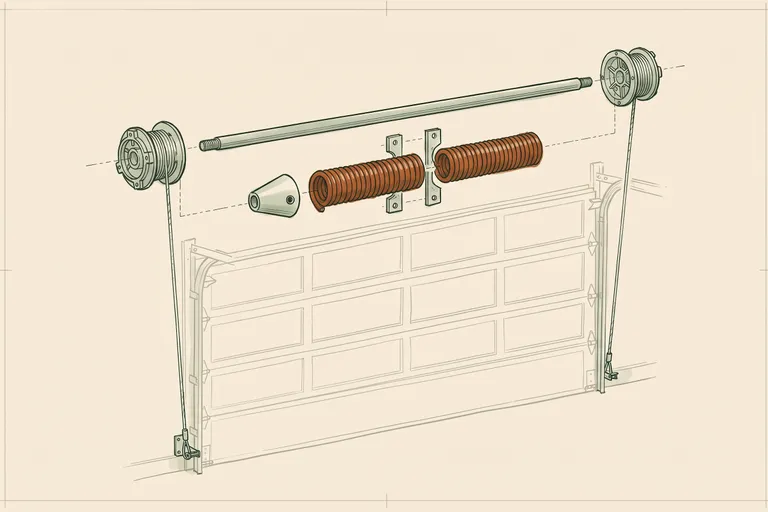
On a torsion setup, the spring winds tighter as the door comes down and releases that energy as the door rises.
On an extension setup, the springs run alongside the horizontal tracks, often with a safety cable threaded through each coil.
Cables run from the bottom corners of the door up to the spring assembly, so trouble with a spring, a cable or the bracket that anchors it can drop or throw the door with little warning.
Stop: this part is under high tension.
A garage door spring stores a great deal of force, and it can let go without any warning. Stop here and call a trained technician.
Stop: the cables are under high tension.
Lift cables carry the weight of the whole door, and a loose end can whip or let it fall. Stop, stay clear, and call a trained technician.
The parts under load
What is actually holding the door up
A torsion assembly sits on a shaft above the door, with a winding cone at the end, set screws that lock the cone in place, drums that take up the cable and a bracket at each bottom corner.
Every part in that chain is under load, so disturbing a fitting can let the rest move suddenly and violently.
Adjusting, winding, removing or replacing these parts is work for a trained garage door technician with the proper tools, and this page gives no steps for it, on purpose.
Ordinary tools from a home workshop do not make the job safe, because the hazard comes from the stored energy and not from how easy the parts are to reach.
Stop: set screws hold the tension in.
The set screws on a garage door spring keep high tension locked in place, and loosening one can release it all at once. Stop and call a trained technician.
Stop: cones and drums are under high tension.
The winding cones and cable drums at the ends of a door spring hold a great deal of stored force. Stop and call a trained technician.
If a spring has snapped, a cable hangs slack or frayed, or the door sits crooked in its tracks, stop using the door and the opener.
Keep people, pets and vehicles out of the door’s path, and arrange for a trained garage door technician to look at it.
From a distance
What you can safely watch
You do not need to touch anything to spot trouble.
Standing well back with the door closed, you can see whether a coil shows a gap, whether the metal looks rusty or flaking, and whether a cable looks frayed or loose on its drum.
Watch the door travel from the side of the garage rather than from underneath, and notice whether it rises level or favors a side.
Write down what you saw and heard, whether it happens on opening, closing or both, and whether it rises level or favors one side. Do not lift the door. Its weight and the tension in the springs make a hand test unsafe.
Photos taken from a safe distance help as well, since a technician can often narrow down the likely parts before arriving.
Notes like these also keep you from guessing at causes, which matters because several different failures can look alike from the floor.
What the clues often mean
- A loud bang from the garage, followed by a door that will not rise, often means a spring has broken.
- A strained opener, or a door that creeps or slams down under it, points toward lost spring tension. Do not lift the door.
- If the door climbs crooked with a corner lagging behind, a cable may have slipped or a spring may be weakening.
- Rust, stretched coils and fraying strands are signs of wear that deserve a professional look before something fails.
- Dropping fast instead of closing smoothly suggests the counterbalance is no longer doing its job.
How the balance works
The springs carry the weight, the opener guides
Torsion
Drums sit at the ends of the shaft, and the lift cables wrap around them. As the door goes up, the coil unwinds and hands that stored energy back as lift.
If one breaks: it usually stays on its shaft, but the sudden loss of lift can still bring the door down hard or leave it stuck.
Extension
On an extension setup, the springs run alongside the horizontal tracks, often with a safety cable threaded through each coil.
If one breaks: a stretched spring that snaps can fly through the garage, which is why a cable through the middle of each spring matters.
Running the opener against failed springs strains the motor, the drive and the door itself, and it can turn a repairable problem into a costly one.
Work inside the opener housing is electrical, so it also belongs with a licensed electrician.
Thinking of doing this yourself? Stop. Read why, on the safety page
Everyday habits
Habits that keep a household safe
Is it safe to stand under a garage door?
Not while it is moving, and not while it is held up by a worn or untested balance system.
The door is among the largest moving objects in a home, and a closing panel does not stop for a person, a pet or a bicycle.
Step clear of the doorway until the door has finished traveling, and resist the urge to dash beneath a panel on its way down.
What should children learn about garage doors?
Children should understand that the door is not a toy and the doorway is not a play area.
Teach them to keep fingers away from the seams between panels, where the hinges can pinch hard as the sections fold.
Keep remotes and keypad access out of reach of small children, and teach older kids never to race a closing door.
Say it plainly and repeat it: the door is for adults to operate.
What about the emergency release handle?
Every adult in the household should know where the handle is, and that pulling it frees the door from the opener. Children should be told to leave it alone.
A raised door with weak springs can crash down once it is freed from the opener. Using the handle on a door that is stuck open is work for a trained garage door technician.
If the door is stuck partway up, keep clear and call for help instead of pushing on it.
Around the door
Keep the floor beneath the door clear of boxes, tools and toys so the panels have nothing to land on or jam against.
Listening for changes in sound each time the door runs is a safe habit that helps you catch trouble early.
Leave the fittings that anchor the cables alone, along with the brackets and the spring hardware, because they are attached to parts that are under load.
Sounds
Is a noisy door dangerous?
Not every noise is an emergency, and not every quiet door is healthy.
Squeaks and rattles often come from dry hinges, loose bolts or rollers that need attention, and those are small problems that cost little when caught early.
Grinding, popping or a sharp bang is different, because it can mean a part under tension is wearing or has already failed.
A door that shudders or strains while moving is asking for help, and ignoring it lets wear spread to the parts around it.
A useful test is whether the sound changes how the door behaves: noise with smooth travel is less urgent than noise with a heavy, crooked or jerky door.
If something has gone wrong
What to do while you wait for a technician
Stop using the door and the opener, and tell everybody in the household not to try them.
Keep people, pets and vehicles out of the path of the door, including the space just outside it.
Photograph any visible damage from a safe distance, without leaning over or reaching toward the parts.
Write down the sounds you heard, when they began and how the door behaved just before it stopped working.
Contact a trained garage door technician rather than a general handyperson, and describe the symptoms in your own words.
Choosing who comes to look at it
Springs and cables are not a place to economize on skill, and a low-priced offer from somebody without the right tools is a poor trade.
Ask a provider to explain what is wrong in plain terms, which parts need replacing and why, and what a sound repair looks like when it is finished.
Ask for proof of license and insurance, and ask to see worn parts after they come off the door.
A good answer is specific about the part and the symptom, rather than a vague claim that the whole door needs replacing.
A provider who pushes you to decide on the spot, or who cannot say which part failed, deserves more questions before you agree to anything.
Keep reading
Where to go next
Corrections and ideas
Found a mistake or a gap?
Tell us about an error on a page, a topic we should cover, or anything else about this site. A person reads messages that are not spam and replies by email, and we correct the page if it needs it.
- Tell us which page and what to change
- We read it
- We reply by email