Guide · Diagnose
Signs Your Garage Door Is in Trouble
Published
What the common changes in sound, speed and posture tend to mean, which ones you can safely watch, and which belong to a trained garage door technician.
An independent guide to home services. We are not a contractor and do not do the work.
Short answer
How do you know a garage door needs repair?
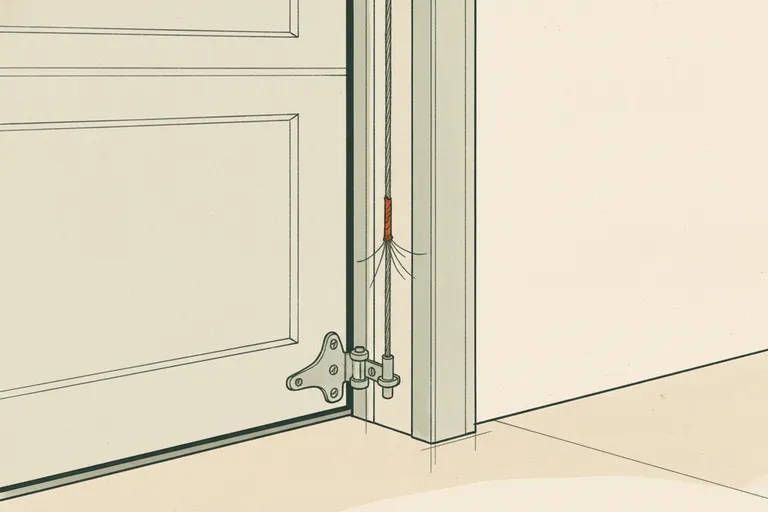
A garage door seldom fails without a hint. Watch for a tilt as it rises, a strained or creeping door, a reversal for no clear reason, new groaning, a frayed cable or a gap in the spring coil. Watch and listen from the floor, note what you see, and leave springs and cables to a trained technician.
A garage door is a heavy, moving machine, and it seldom fails without hinting first. The hint usually arrives as a change in sound, speed or posture well before a part gives out.
A change matters more than a long-standing quirk, because an old door that has always rattled is less alarming than a quiet door that suddenly starts to groan.
Movement
Changes in how the door moves
Seven things worth noticing. A pair appearing together is a stronger hint than a single one.
- A side of the door rises or lowers ahead of the other side, leaving a visible tilt.
- The door looks like it is struggling, or it creeps downward instead of staying where the opener left it.
- The opener hums, strains or runs more slowly than it used to, with or without the door moving.
- The door reverses partway down or stops for no clear reason.
- A cable looks frayed, slack or hanging, or a coil of the spring shows a gap.
- Rollers wobble in the track, or the track looks bent, dented or pulled away from the wall.
- Panels show cracks near the hinges, sagging sections or gaps along the edges that were not there before.
- A trained technician checks the springs and cables; from the floor, note the symptom (sound, crooked door, gap) and report it.
A single symptom deserves attention, but a pair appearing together, such as a crooked rise and a straining opener, is a stronger hint that the hardware has fallen out of balance.
Balance is tested only by a trained garage door technician, because a weak spring can make a released door drop or jerk.
Stop: springs and cables are under high tension. Read why, on the safety page
Anatomy
How the door holds itself up
A counterbalance system, not the motor, handles the weight.
- Panels and hingesMany garage doors are built from horizontal sections joined at hinges, so the door can bend around the curve in its track.
- SpringsCoiled springs store energy as the door lowers and give it back as it rises, although the layout differs between door types.
- CablesCables link the lower corners of the door to that spring assembly and share the pull between the sides.
- Rollers and tracksRollers ride inside steel tracks that climb the wall, curve and then run level overhead, which lets the panels fold at the hinges and tuck out of the way.
- BalanceWhen everything is in balance, the springs carry the door’s weight, which is a useful picture of a healthy system even though checking it is a job for a professional.
The opener
What the opener is and is not doing
The opener steers a balanced door along its path; it was not designed to haul dead weight upward.
When a spring weakens or a cable slips, the motor inherits a load it was never meant to carry, and it answers with slow travel, loud strain or sudden stops.
So a struggling opener is often a symptom, not the fault, and swapping it alone can leave the real problem in place.
A door that reverses for no visible reason is a different story, because that behavior often traces back to the photo eyes near the floor or to the settings that tell the opener where to stop.
Stop: the safety sensors must keep working. Read why, on the safety page
Safety check
Does your opener reverse on its own?
A modern opener should stop and reverse when something is in the doorway, and the sensors near the floor on each side detect it. The date it was made tells you whether the federal rule covers it.
Openers made on or after January 1, 1993 must meet the federal entrapment standard
Three dates from 16 CFR Part 1211. The years are not to scale.
Openers made from this date must carry the month or week and year they were made, and say they conform.
16 CFR 1211.19The entrapment protection standard applies to every residential opener made from this date.
16 CFR 1211.1An amendment was published. The eCFR lists it as pending, so check the current text before relying on this page.
91 FR 68459
You can read the date label on your opener from the floor. If there is no label, or it shows a date before 1993, ask a trained technician about the opener.
Show the numbers
| Date | What happens | Where |
|---|---|---|
| January 1, 1991 | Openers made from this date must carry the month or week and year they were made, and say they conform. | 1211.19 |
| January 1, 1993 | The entrapment protection standard applies to every residential opener made from this date. | 1211.1 |
| October 30, 2026 | An amendment was published. The eCFR lists it as pending, so check the current text before relying on this page. | 91 FR 68459 |
The eCFR lists a pending amendment (91 FR 68459, published October 30, 2026). The dates here are the rule as of November 1, 2026.
Source U.S. Consumer Product Safety Commission, 16 CFR Part 1211, through the Electronic Code of Federal Regulations (as of November 1, 2026). Open the source (opens in a new tab). Checked .
A door that ignores the beam, or that reverses for no visible reason, needs a technician to look at the sensors and the opener settings.
Leave the opener housing closed, since anything inside it is electrical work for a professional.
Sounds
Reading the sounds
What does it sound like?
Pick a sound to see where it usually comes from.
Dry metal dragging on metal, often at hinges or roller bearings, or at the spring-shaft plates, which are technician-only.
Loose hardware, or an opener that has worked loose from the ceiling and carries vibration into rooms above. Report it to a trained garage door technician.
Tired rollers, a chain that has lost its oil, or a track that has drifted out of line.
A tiring spring, or hinges that stick as they flex.
The typical sound of a spring or cable letting go.
Stop: springs and cables are under high tension. Read why, on the safety page
- Hinges
- Rollers
- Track
- Spring-shaft end plates
- Spring
- Cable
- Chain
- Opener mount
- Loose hardware
| The sound | What it usually points to |
|---|---|
| Squeak | Dry metal dragging on metal, often at hinges or roller bearings, or at the spring-shaft plates, which are technician-only. |
| Rattle | Loose hardware, or an opener that has worked loose from the ceiling and carries vibration into rooms above. Report it to a trained garage door technician. |
| Grinding or scraping | Tired rollers, a chain that has lost its oil, or a track that has drifted out of line. |
| Popping | A tiring spring, or hinges that stick as they flex. |
| Sharp bang | The typical sound of a spring or cable letting go. Stop using the door |
A bang from the garage can be loud enough to sound like something heavy fell off a shelf.
After a sound like that, leave the door and opener alone and look from a distance for a gap in a coil or a cable lying slack.
Noise questions
Why a door gets loud
Why is your garage door so loud?
Noise is wear announcing itself, and the cause depends on the kind of sound and the moment it happens.
A door that is loud only while rising may have a hardware problem, while a door that is loud only while closing can point toward a balance or track issue.
If the noise comes from the motor unit, such as a whine, a buzz or a chain slapping, the opener is the likelier source.
With the door fully closed and the opener unplugged or its power off at the breaker, wiping grime from the track and lubricating hinges and roller bearings, all reachable from the floor or a low step stool, with the product the maker recommends often calms a door that is merely dry. Anything higher goes to a trained garage door technician. Do not use a ladder for any garage door task.
A technician can fit vibration isolators on the opener mount; this is overhead work, not a homeowner job, and it does nothing for a door that is out of balance.
When the noise stays after the cleaning, the probable cause is wear, and a technician can say which parts are worn.
Springs, cables, winding parts and bottom brackets hold stored energy and belong to a trained garage door technician.
- If you see a gap in a coil, a frayed cable or a door that sags, creeps or rises crooked, or an opener that strains, stop using the door and the opener, keep clear and call a trained garage door technician.
- Do not stand or park under a door you suspect is unbalanced, and leave all testing of it to the technician.
Before you call
Notes to gather before you call
Details like these help a technician narrow the cause over the phone and bring suitable parts, which often shortens the visit.
Small problems such as dry hinges or a misaligned photo eye are inexpensive for a technician to put right, and fixing them early keeps wear from spreading to bigger parts.
Left alone, a weak part passes its strain to the parts around it, and a minor repair turns into a larger one.
If the symptoms suggest the door is near the end of its life, read the guide on repair versus replacement. When you are ready to hire someone, How to Choose a Garage Door Contractor covers what to ask.
Note whether the problem happens while opening, while closing or in both directions.
Write down what the sound is like and when it occurs, for example at the start of travel, near the top or at the very end.
Listen to the motor unit while it runs, and notice whether the door budges at all or only the opener makes noise.
Take clear photos from a safe distance of anything visibly worn, such as a frayed cable, a bent track section or a cracked panel.
Mention recent events, such as a vehicle bump, a cold snap or a remote that began acting oddly.
Keep reading
Where to go next
Corrections and ideas
Found a mistake or a gap?
Tell us about an error on a page, a topic we should cover, or anything else about this site. A person reads messages that are not spam and replies by email, and we correct the page if it needs it.
- Tell us which page and what to change
- We read it
- We reply by email