This website is an independent guide to home services.

Blog · Opener and sensors

Garage Door Won’t Close? Safe Checks Before Calling Anyone

Published

A door that refuses to close is telling you something, and how it fails is the first hint.

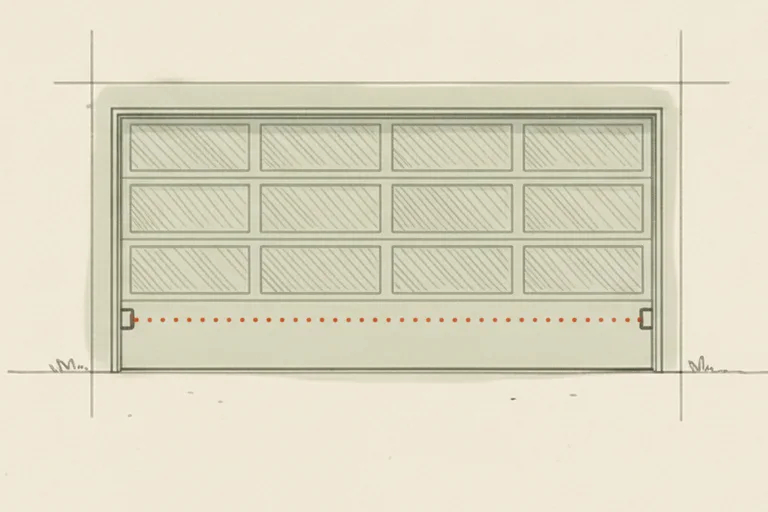
Sketch of a garage door opening with a safety sensor low on each track and a dotted beam between them
Fig. 1Safety sensors low on each side of the opening, with the beam between them. Drawn for explanation.

Short answer

Why won’t my garage door close?

The cause is often the wall control, the sensors near the floor, or the opener’s power. The control and sensor lenses can be checked from the floor. An overhead or unreachable outlet goes to an electrician or a technician. If the door is crooked or a spring or cable looks damaged, keep clear and call a trained technician.

Each behavior points toward a different group of parts, and several of those checks are safe to make while standing well back from the door. This post sorts the checks into what you can safely see and what belongs to a trained garage door technician.

Order of safe checksA timeline in three stations: how the door stays balanced, checks from the floor, and the remote failing while the wall button works.BalanceSprings holdFloor checksFrom the floorRemote failsWall button works
Order of safe checks: balance, checks from the floor, and a remote that fails while the wall button works.

Balance first

How the door stays up without the opener

Picture a stack of flat panels joined by hinges, with small wheels at the edges that ride in metal guides fixed to the wall and ceiling.

Because the panels weigh a great deal, the springs carry most of the door’s weight, and that part is work for a trained garage door technician. Springs in good shape keep a half-open door where it is.

The opener is more of a guide and a pusher than a lifter, since it keeps the door moving along its path and decides where to stop. That split matters when the door will not close, because the fault sits either with the opener and its controls or with the springs, cables and track.

When that system is healthy, the springs carry most of the door’s weight.

Stop: springs and cables are under high tension. Read why, on the safety page

Three ways it fails

Match what the door does to a cause

Start with the behavior you see, then read across to the likely suspects.

A

Why does your garage door go up but not come down?

This is the classic sign of a blocked safety beam or a sensor that has drifted out of line.

Two small sensors sit near the floor on either side of the opening, with an invisible beam between them. While something blocks that beam, the opener will not close the door.

Look for a dim or blinking light on a sensor, a lens covered in dust or cobweb, a mount that was bumped and now points at the ground, or a stored item leaning into the beam.

With the door fully closed and the opener unplugged or its power off at the breaker, wipe the lenses with a soft cloth, reachable from the floor or a low step stool; anything higher goes to a trained garage door technician. Then clear the doorway and restore power, and watch whether the lights settle to steady. An opener light that blinks while the door stays up often says the same thing.

B

Why does your door touch the floor and then reverse?

A door that reaches the floor and heads straight back up is either sensing resistance that is not there or meeting real resistance from something in the way.

Look along the floor line for a pebble, a lump of ice, a bent bottom seal or debris sitting in the path.

If the floor is clear, the opener’s travel or force settings may have drifted. Do not change the opener’s settings. Wrong settings can stop the door from reversing on an obstacle. Call a trained garage door technician to check them.

If the door is also crooked, noisy or hard to move, the reversing may come from a hardware problem rather than a settings problem, and the sensible move is to stop and call.

C

What if the opener runs but the door barely moves?

An opener that hums, clicks or strains while the door does not move suggests the door is too heavy for the opener.

That usually means the counterbalance has lost its strength, a cable has slipped, or the door is binding in its track.

None of those is a job for a homeowner, so stop pressing the button, since repeated attempts can strain the opener and the door.

From the floor

Checks you can make from the floor

  1. Power

    If the opener’s outlet is within easy reach while you stand on the floor, check that it is plugged in and has power. If it is overhead or out of reach, or the plug or cord looks damaged, call an electrician or a trained garage door technician to check it. Never climb a ladder to reach the opener. Do not use a ladder for any garage door task.

  2. Wall control

    Look at the wall control for a lock or vacation mode, which can make the opener ignore the remote while the wall button still answers.

  3. Sensors

    Clear the doorway, look at both sensor lights and wipe the lenses (door fully closed, opener’s power off).

  4. Watch

    Watch the door from a safe distance and note exactly where it stops, whether it moves unevenly and what sound the opener makes.

  5. Record

    Write the pattern down, or record a short video from well back, so a technician can narrow the cause over the phone.

Is a noisy door a sign of danger?

Not always, but a shaking, popping or squealing door is worth a closer look.

Dry hinges, tired rollers or loose hardware can make plenty of noise and are small matters for a technician, while a sudden bang often means a part under tension has failed. Grinding, scraping or a door that rubs at a side may mean a bent track or a roller that has left its channel.

If you see or hear this

If you see a gap in a spring coil, a frayed or slack cable or a door sitting crooked, or if you hear a loud bang from the garage, keep clear of the door. Do not run the opener, keep people and vehicles out of the door’s path, and call for service.

Remote or wall button

When the remote fails but the wall button works

The wall button is wired to the opener, so it keeps working when the wireless side has trouble. That points to a weak remote battery, a remote that lost its pairing, or interference near the receiver.

Try a fresh battery, then stand closer to the opener’s receiver, outside the door’s path, then try another remote if you own a spare.

If every remote fails, the receiver inside the opener becomes the likelier cause, and because that means electrical work inside the unit, it is a job for a technician.

Thinking of doing this yourself? Stop.

Wiring and panels can cause a shock or a fire, even when everything looks switched off. Stop there and call a licensed electrician.

Opener or door?

Watching and listening tells you a good deal without touching anything on the door.

Telling an opener problem from a door problem

If the door travels smoothly and evenly and only refuses to lower or reverses near the floor, sensors and settings are the likelier suspects.

Judging whether a door is balanced calls for a trained garage door technician with the right tools and a safe plan. A trained technician checks the springs and cables; from the floor, note the symptom (sound, crooked door, gap) and report it.

Before you call

What to tell the technician

Five things a technician can use over the phone. Take the photo or short video from well back, and keep clear of the springs and cables while you do.

Notes for the technician
  • Whether the trouble happens when opening, when closing or both.
  • Exactly where the door stops or reverses, and whether it moves evenly.
  • How the opener behaves: silence, humming, clicking, or a blinking light.
  • The state of the sensor lights after the lenses were wiped.
  • A bang, a gap in a coil or a slack cable that you noticed from a distance.