Blog · Winter care
Cold Snaps and Your Garage Door
Published
A garage door is a heavy, balanced machine, and cold weather touches nearly every part of it.
Short answer
What does cold weather do to a garage door?
In low temperatures the lubricant on rollers and hinges turns stiff, seals harden, and melted snow can refreeze under the bottom edge, so the opener works against more drag. Watch a full cycle from a safe distance, look at the bottom edge and the sensor lenses, and leave springs and cables to a trained technician.
Winter trouble is easy to recognize once you know what cold does, and much of it can be watched from a safe distance.
What cold does to a garage door
Lubricant on rollers and hinges turns stiff in low temperatures, so the door moves with more drag than it does in mild weather. The opener then has to work against that drag, and a motor that ran quietly in autumn may sound strained or slow on a frosty morning.
Rubber and vinyl seals along the bottom edge harden as well, and a seal frozen to the slab can tear when the door starts to rise.
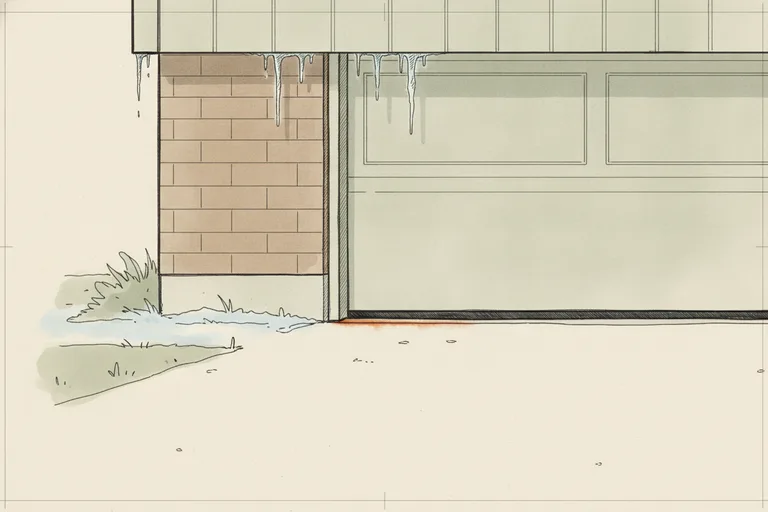
Metal parts shrink slightly in the cold, which can change the fit between rollers and tracks and make a quiet door rattle or squeal. Melted snow that runs under the door and refreezes can glue the bottom edge to the floor, and an opener that keeps pulling against that bond can damage panels or hardware.
Frost can also settle on the small sensor lenses near the floor, which makes the door behave as if something were in its path.
How cold Boise gets, month by month
The Boise airport weather station keeps the longest record, and its averages show when the cold bites and how little of it is snow.
Boise averages about 108 freezing mornings a year, when springs and openers struggle
Average days each month with a low at or below 32 °F, with the average low as a line.
- Days with a low at or below 32 °F
- Average low (°F) (right axis)
Show the numbers
| Month | Days with a low at or below 32 °F | Average low (°F) |
|---|---|---|
| January | 25.5 | 25.5 |
| February | 20.1 | 29.0 |
| March | 11.2 | 34.9 |
| April | 5.2 | 39.6 |
| May | 0.8 | 47.5 |
| June | 0.0 | 54.1 |
| July | 0.0 | 61.9 |
| August | 0.0 | 60.8 |
| September | 0.2 | 52.6 |
| October | 3.7 | 41.5 |
| November | 16.3 | 31.7 |
| December | 25.2 | 25.4 |
| Year | 108.2 |
This is the airport station. Foothill and valley-edge homes can run colder. Normals are 1991-2020 averages, not a forecast.
Source NOAA National Centers for Environmental Information, U.S. Climate Normals 1991-2020, Boise Air Terminal (station USW00024131). Open the source (opens in a new tab). Checked .
Boise is cold more than snowy: about 18 inches of snow in a normal year
Average snowfall in inches for each month.
- Average snowfall (inches)
Show the numbers
| Month | Average snowfall (inches) |
|---|---|
| January | 5.3 |
| February | 3.3 |
| March | 1.2 |
| April | 0.1 |
| May | 0.0 |
| June | 0.0 |
| July | 0.0 |
| August | 0.0 |
| September | 0.0 |
| October | 0.1 |
| November | 2.0 |
| December | 5.6 |
| Year | 17.6 |
This is the airport station. Values are 1991-2020 averages, not a forecast.
Source NOAA National Centers for Environmental Information, U.S. Climate Normals 1991-2020, Boise Air Terminal (station USW00024131). Open the source (opens in a new tab). Checked .
Signs your door is struggling in winter
- The door rises slowly or hesitates at the start of its travel, then moves more freely as the motor warms up.
- A groan, pop or squeal appears that was absent in warmer months, especially from the hinges or rollers.
- The door stops partway or reverses on the way down, which can point to stiff travel, a frozen seal or sensors fogged with frost.
- A gap opens along the bottom edge or the sides, letting in daylight and drafts.
- A single side of the door rises higher than the other, which suggests uneven tension and calls for a technician.
When trouble persists, crooked travel, a slack cable or a visible gap in a spring coil all call for a professional, not for experimenting. For a wider list of warning signs, read Signs Your Garage Door Is in Trouble.
Why to keep your distance from springs and cables in the cold
The springs do the lifting: they load up as the door comes down and give that energy back on the way up, while cables tie the bottom corners to that assembly. Because the door is balanced against them, a worn spring can feel like a heavy door or a struggling opener, and the strain often becomes obvious in cold weather.
Stop: springs and cables are under high tension. Read why, on the safety page
If you hear a bang, see a frayed cable or notice a gap in a coil, stop using the door and the opener, and keep people and vehicles out of its path. Take a photograph from a safe distance so the technician can see the problem before arriving.
Read Garage Door Spring and Cable Safety: When to Call a Professional for more on why these parts are risky.
Listen first
Is a noisy garage door dangerous?
What the noise sounds like narrows down what is wrong.
| What you hear | What it often points to |
|---|---|
| A squeal or chirp | Often dry hinges or rollers, a small problem when caught early. |
| Shaking or popping as the door travels | Can mean loose hardware or a shifted track, and left alone it tends to spread wear to other parts. |
| A grinding sound from the opener | Points to the motor or its drive. |
| A loud bang | Points to a spring or cable and should be treated as a safety event. |
Safe checks
What to look at on a cold morning
Watch a full cycle
Watch the door through a full opening and closing, and note where it hesitates, shakes or makes noise.
Look at the bottom edge
Look along the bottom edge for ice or packed snow that could hold the door to the floor. With the door fully closed and the opener unplugged or its power off at the breaker, ice and dirt at the floor edge can be cleared from the floor or a low step stool; anything higher goes to a trained garage door technician. Do not use a ladder for any garage door task. Do not pry the door. A door forced loose can drop or jump the track, and force can also damage the door and its bottom seal. Call a trained garage door technician to check a door that stays stuck.
Wipe the sensor lenses
With the door closed and the opener’s power off, wipe frost or dirt from the safety sensor lenses near the floor and make sure nothing blocks the beam between them.
Leave the springs and cables alone
A trained technician checks the springs and cables; from the floor, note the symptom (sound, crooked door, gap) and report it.
Photograph and write it down
Photograph anything odd, and write down whether it happens when opening, closing or both.
What simple upkeep helps?
The safe list is short: looking, listening, clearing ice and dirt from the floor edge, wiping the sensor lenses and a yearly auto-reverse test. The ice and the lenses are done with the door fully closed and the opener unplugged or its power off at the breaker. The opener’s manual describes the auto-reverse test, usually with a soft object such as a rolled towel on the floor in the doorway.
Run the test only when the door travels smoothly and no spring or cable looks damaged.
Keep your hands and body clear of the door during that test. If the opener has no label or is dated before 1993, call a trained garage door technician to check it instead. If the door does not reverse, stop using the opener and call a trained garage door technician to inspect it.
With the door fully closed and the opener unplugged or its power off at the breaker, wiping the tracks clean and putting suitable lubricant on hinges and rollers also helps in cold weather, on parts reachable from the floor or a low step stool; anything higher goes to a trained garage door technician. Do not use a ladder for any garage door task. Keep your hands away from the springs and the bottom brackets. If the opener’s outlet is overhead, a trained garage door technician does the job. Anything involving tension, cables or opener wiring belongs to a professional.
Garage Door Maintenance: Simple Checks Through the Year covers a routine across the seasons.
The opener in winter
The opener is meant to guide a balanced door, not to haul a heavy one.
A door that only moves with a straining motor is telling you about balance or friction. Turning the opener up to push through that resistance tends to hide the cause and add wear.
If the door seems heavy or sluggish, describe the symptom to a technician instead. For more on how the opener and electrical work relate, see Garage Door Opener Types and Electrical Work Basics.
Quick answers
Upkeep and servicing
Two short answers on how much attention a door needs through the year.
How often should a garage door be serviced?
The right rhythm depends on how often the door is used and how harsh the weather gets where you live. A busy door that goes through frost and thaw deserves closer attention than a seldom-used door in a mild climate.
A professional visit before the cold season lets a technician judge the springs and the balance with proper tools, deal with loose hardware and set up the opener properly. It is also a good time to ask how worn each part looks.
More short reads
Other questions on the blog
Each one answers a single question and stands on its own.