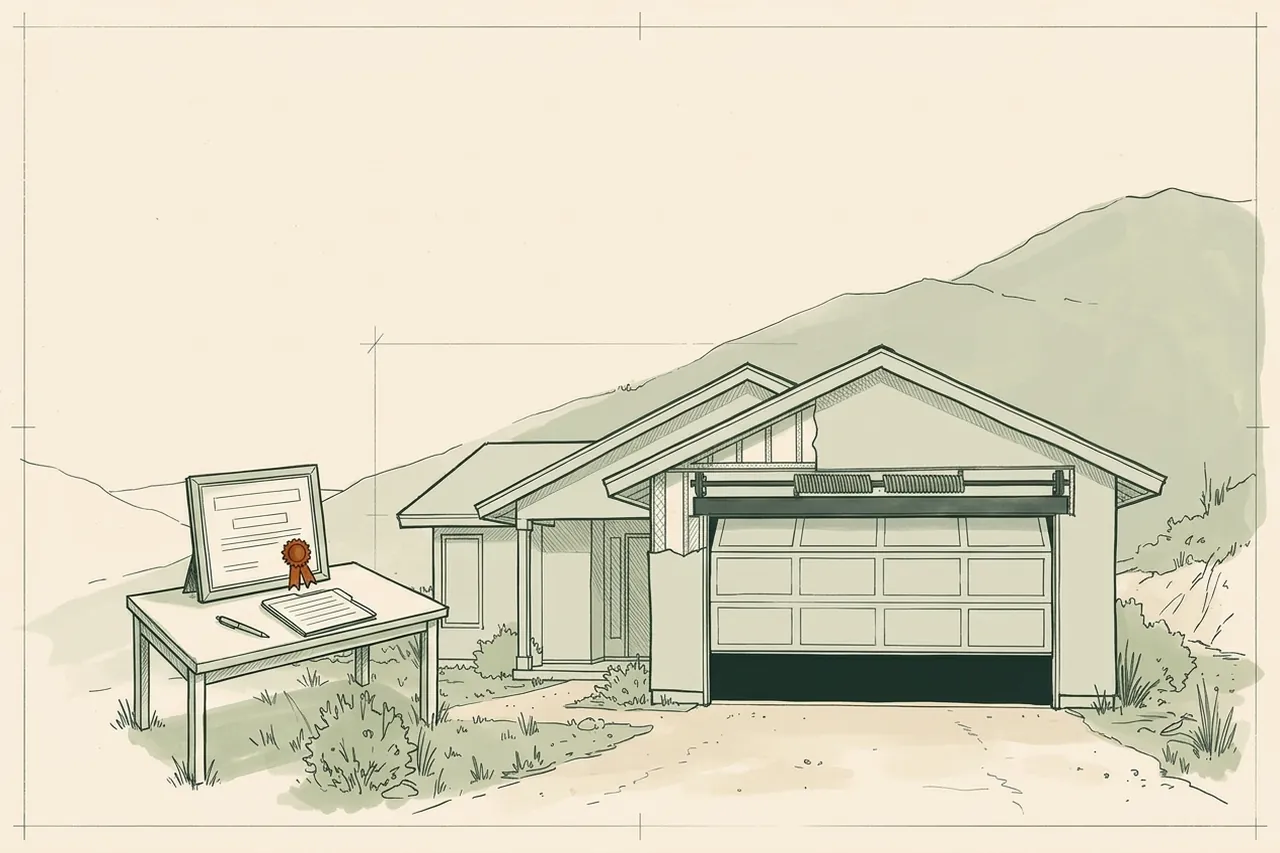
The door is the largest moving object in many homes, and the work around it mixes heavy hardware, stored spring energy and sometimes wiring, so the person you hire matters more than the brand on the panel.
Registration and what it tells you
Many homeowners want one clear answer on where a contractor stands with the state, then feel reassured or alarmed by whatever paper they are shown.
According to the Idaho DOPL contractor FAQ, Idaho’s Contractor Registration Act requires registration, not licensure.
The same FAQ adds that anyone who does a construction job over $2,000.00 (materials and labor) and is not exempt must register.
Idaho Division of Occupational and Professional Licenses (DOPL), Contractor FAQ: Frequently Asked Questions (opens in a new tab), checked November 15 and November 18, 2026.
So a provider quoting a big replacement should be able to say, plainly, where their registration stands.
- Ask for proof of registration and proof of insurance, and write down the names exactly as they appear on the papers.
- Check that the business name on the quote matches the name on those papers, because a mismatch is a reason to ask more questions rather than to assume the worst.
Registration only shows that a business is on file. It says nothing about how careful the crew is on a hard spring job or whether they return calls. For that, rely on the questions below and on how the provider behaves during the estimate.
Doing work on your own home: the registration rule
The City of Boise guide says a homeowner does not need to register as a contractor with the State of Idaho for a project on the homeowner’s primary residence.
City of Boise, Homeowner’s Guide to Residential Construction (Boise’s Building Permit Process) (opens in a new tab), checked .
This concerns registration, not whether spring or cable work is a sensible job for an owner. The exemption covers paperwork, not danger: permission to do a job does not make anyone safer around a loaded spring.
Torsion springs, extension springs, lift cables and bottom brackets hold stored energy, and a slip can cause serious injury.
Stop: this part is under high tension.
A garage door spring stores a great deal of force, and it can let go without any warning. Stop here and call a trained technician.
Stop: the cables are under high tension.
Lift cables carry the weight of the whole door, and a loose end can whip or let it fall. Stop, stay clear, and call a trained technician.
Spring and cable work is for a trained garage door technician. See Garage Door Spring and Cable Safety: When to Call a Professional for what can be observed safely from a distance.
Does swapping a door need any local sign-off?
The City of Boise homeowner guide lists new or replacement windows or door openings among the building permits it requires.
Whether a straight swap of a garage door inside the same opening falls under that wording is a fair question, and the answer should come from the city rather than from a salesperson’s memory.
- Ask the city whether your specific job needs a permit, and ask the installer who would obtain it if it does.
- Ask the installer to explain the local requirements in plain words, then check their answer against what the city tells you.
Requirements change, so a confident answer from a past job is a starting point, not the last word.
Electrical work needs its own question
A new opener may involve a circuit or an outlet. According to the City of Boise homeowner guide, the electrical permit category covers installing, changing or repairing any hard wired electrical system.
Thinking of doing this yourself? Stop. Read why, on the safety page
Ask whether the opener needs new wiring, and who would do the wiring.
The detailed picture lives on Boise Garage Door Permits, Electrical Work and Idaho Contractor Registration, and the wiring side is explained in Garage Door Opener Types and Electrical Work Basics.
City of Boise, Homeowner’s Guide to Residential Construction (Boise’s Building Permit Process) (opens in a new tab), checked .
Why the paperwork matters later
According to the City of Boise homeowner guide, required permits provide a permanent record of the work performed and the inspections conducted on a project.
City of Boise, Homeowner’s Guide to Residential Construction (Boise’s Building Permit Process) (opens in a new tab), checked .
A record like that helps when a door fails years later, when a house is sold or when a new technician wants to know what was changed.
A contractor who is relaxed about paperwork on a job that plainly calls for it tells you how they run the rest of the work.
Questions to put to every provider
Who comes to your home
Ask who will actually be at your home, whether it is an employee or a separate subcontractor, and whether they can tell you the name beforehand.
Registration and insurance
Ask for proof of registration and insurance, and compare the business name with the one on the written quote.
What the quote includes
Ask what the quote includes: the door, the hardware, the opener, haul-away of the old door and any adjustments after installation.
What is replaced, what is reused
Ask which parts are being replaced and which are being reused, and why, so that a worn roller or a tired hinge is not quietly left in place.
Springs and cables
Ask whether the visit will involve springs or cables, and listen for an answer that treats them as technician work with proper tools.
How they explain a problem
Check how the provider explains a problem: a good answer names the part, the symptom and the reason, instead of a vague statement that everything needs replacing.
After the job
Ask what happens if the door misbehaves soon after the job, and who you call.
A short checklist version of these questions sits on Checklist: Before You Hire a Garage Door Contractor, and the longer discussion is in Questions to Ask a Garage Door Provider Before You Hire.
When quotes arrive, compare what each one covers line by line rather than looking only at the bottom figure; What Drives Garage Door Project Prices and How to Compare Quotes explains what moves a price.
Signs that a job is bigger than it looks
Knowing a little about how the door works helps you judge what a provider tells you. Picture a column of panels joined by hinges, with small wheels on each side running along metal rails that bend toward the ceiling.
- SpringsStore energy as the door lowers and give it back as it rises.
- TracksSmall wheels on each side run along metal rails that bend toward the ceiling.
- PanelsA column of panels joined by hinges.
- Lift cablesConnect the lower corners to that spring assembly.
- OpenerIts job is to guide a balanced door along the track.
All that weight is carried by the springs, which wind up as the door lowers and unwind as it climbs, and by lift cables that connect the lower corners to that spring assembly.
That is why the opener is not holding the door up. Its job is to guide a balanced door along the track, and a motor that strains is often a symptom of a balance problem rather than a weak motor. If a provider suggests a new opener for a door that strains the opener or rises crooked, it is fair to ask whether the balance was checked first.
| What you notice | What it can point to |
|---|---|
| A door that rises crooked, with one side lagging | Can point toward a slack cable or uneven spring tension. |
| A visible gap in a spring coil or a frayed cable strand | A reason to stop using the door. |
| A door that reverses on its own | Often points to the sensors or the opener’s settings rather than the springs. Call a trained garage door technician to check them. |
| Squeals and shaking | Often come from dry hinges, worn rollers or loose bolts, which are small problems that grow when ignored. |
Is a noisy garage door dangerous?
Often it is only a nuisance, such as dry hinges or a loose hinge bolt, but a sudden loud bang can mean a spring has broken; stop using the door and call a technician.
Keep people and vehicles away from the door’s path and do not run the opener until a technician has looked at it. Notice when the sound happens, whether on opening, closing or both, and whether the door rises level; those details let a technician arrive with the right parts.
Signs Your Garage Door Is in Trouble goes through the symptoms in more detail.
What paperwork should you keep after an installation?
- Keep the written quote, the final invoice, the product details and any coverage papers together in one folder, paper or digital.
- Check that the invoice names the company, lists the parts and carries the date of the work.
- Ask what the coverage includes, what could void it and who to call if something fails.
- Take clear pictures of the finished installation and of the stickers on the door, opener and springs; they make later parts orders and repairs quicker.
- Jot down the day of every service visit, so that repeat trouble, such as the same sensor acting up each winter, becomes easy to spot.
- Check whether the job needed a permit or any local sign-off, and keep that record with the rest.
Where to go next
The choice and the checks remain yours, and everything above applies to any provider you speak with. Repair or Replace Your Garage Door: How to Decide helps if you are still unsure what the job should be.
This website is an independent guide to home services. It is not a contractor and does not perform home services itself. Any businesses mentioned here are separate from this site.